
About us...
MISSION
The School of Sports Integration and Training, Artistic Expression and Labor Development (EIFODEC) is a non-profit social development institution that contributes to raising the quality of life of children and young people with disabilities, promoting their physical, psychological, and occupational empowerment, facilitating their inclusion in society, stimulating the implementation of their rights and committing to the participation of parents and the community in general.
VISION
A well informed, educated and sensitized Bolivian Society, through the contribution of the work of the EIFODEC and other institutions with the same philosophy, methodology, and effectiveness, facilitates the inclusion and participation of people with disabilities and of girls and boys and young people in particular in all their conditions of equality, equity, dignity and independence .
EIFODEC Staff

EIFODEC is an institution founded in 2001, with the purpose of contributing to the integral development of children and young people with disabilities. However, it was not until 2006 that it obtained its own legal entity.
The activites of support to this population are centered in three areas:
-
Sports
-
Corporal, artistic and cultural expression
-
Training, and labour market inclusion
-
Community Based Rehabilitation (RBC)
Each one of these areas promotes diverse activities, aimed at strengthening the potentials of the students to the maximum, encouraging and promoting the development of their abilities and skills with the vision that in the future they will be included in the community. The multidisciplinary team that works in the school, is composed of professionals in Psychology, Physical Education, Artistic Expression, Educational Sciences, and Physiotherapy.

With the firm intention of contributing to the full inclusion of persons with disabilities, the objectives of the school are directed mainly to five groups of the population.
Students: Develop, strengthen and reinforce the potentials, capacities and abilities of children and young people with disabilities through the performance of recreational activities, Sports, corporal expression and capacity Building for the labour market inclusion thus improving their quality of life and facilitating their inclusion process to the community.
Parents and Family: Guide, support and train the family for greater participation, and commitment to the integral development of their children, promoting actions of training, rehabilitation, self-help groups and recreational activities that contribute to the achievement of these purposes.
Institutions: Develop policies and strategies that generate the involvement of community institutions in the field of disability from the formation of an inter-institutional support network.
Community: Promote knowledge, acceptance and inclusion of people with disabilities in all areas of the community.

With the ultimate aim of the full exercise of the rights of persons with disabilities, is that for 17 years as a school we have organized various integration activities with the community.
Among them:
Integrative sports games
Event of departmental level that takes place in the stadium and other sports fields and has the participation of special education centers and regular education units. The characteristic of this event is that athletes with developmental, sensory, and physical disabilities participate. These games are held once a year and gather approximately 600 athletes.
Integrative artistic festival
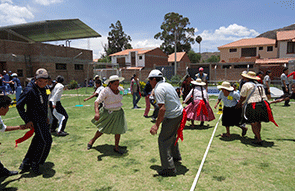
Artistic activity, which takes place once a year and in which children and young people with disabilities participate and recognized artists of our community, the purpose is to show the artistic skills but also to promote a true integration. Family recreational encounters This activity is carried out in the EFODEC, twice a year. The purpose of this event is for the students to participate together with their families in recreational, sports and corporal expression activities, thus promoting the strengthening of family ties.

Sports Area
"From the point of view of physical culture, sports, is a resource of vital importance for the development of potentials of persons with disabilities; which greatly favors their process of integration and inclusion to the community."
Sports and movement are an essential part of the life of any subject. From the movement that the child learns, it makes contact with people and things around him. Physical activity is aimed at developing motoric skills, encouraging cognitive development, promoting personal independence, improving self-esteem, enabling social contact through its collective practice and promoting situations for social inclusion; which is fundamental in the life of every human being and, even more, in people who have some disability.
Not giving due importance to sport, as a key area of integral development, shows the little space that in the past has been given to physical activity in the processes of kills training and rehabilitation of children, young people and adults with disabilities. As a result of this evident gap, in 2002, the School of Sports Training was born as an alternative, aimed at stimulating the development of potentials of children, adolescents and young people in a situation of disability.
This school, unique in the country, has managed to affirm the bases for a pre-sports and sports recreational practice aimed at people with disabilities, providing them with a valuable resource for their social inclusion in the neighborhoods where they come from.


How do we do it…
The work approach is oriented in terms of the population with disabilities making adjustments from an active participatory methodology where the main Protagonist is the individual.
The disciplines practiced in the school are: Athletics - Swimming - Basketball - Handball - Football - GoalBall
Since 2001, EIFODEC has organized and participated in various sporting events promoting activities in surrounding neighborhoods and peri-urban areas of our city and the municipality of Sacaba, with the purpose of promoting the visibility and awareness of people with disabilities in different contexts of the community. An example of this are the awareness-raising activities that EIFODEC has been carrying out for the last years in educational units of the Sacaba municipality, visiting them to promote the theme of disability through sports fraternization activities between students with and without disability.
Another important activity are the SPORTS INTERGRATION GAMES that EIFODEC organizes since 2002. This sporting event is held every year in Cochabamba with the aim of promoting the sports integration of people with disabilities. In the country, the only activity that precedes the Games is the Special Olympics which only promotes Sports for people with intellectual disabilities, unlike the SPORTS INTERGRATION GAMES in which people with all disabilities participate.
It is important to mention that, since 2005, EIFODEC has gone beyond local borders and organizes the NATIONAL SPORTS INTEGRATION GAMES, having made two versions of them, allowing young people with disabilities from different departments of the country to participate and fraternize in this sports festival.
Since 2013, ensuring the sustainability of this macro event, the State, through the Departmental Sports Services, has assumed the responsibility of organizing the SPORTS GAMES.
As of 2014, EIFODEC, together with the Municipal Government of Sacaba is organizing the INTERMUNICPAL SPORTS GAMES; sports activity that aims to integrate athletes with and without disabilities in the municipalities of the Department of Cochabamba.

MAIN ACTIVITIES OF THE SPORTS AREA
Organization and participation in 11 versions of the Integration Sports Games at departmental and national level. Awareness and sports fraternization in regular educational units of the Municipalities of Cercado and Sacaba. Organization and participation in the "First Inclusive Bolivia Plurinational Games President Evo Morales".
RESULTS
-
Development of muscle power and resistance to fatigue
-
Better functioning of vital functions, especially respiratory, cardiovascular and renal functions
-
Contribution in the improvement of skeletal support, avoiding complications such as decalcification or osteoporosis
-
Development of self-esteem and emotional adjustment
-
Increase in self confidence
-
Contribution to socialization
-
Development of feelings of belonging to the group
-
Elimination of depression and anxiety
-
Integration in the sports activities of the neighborhood or community
-
Contribution to a better understanding of people with disabilitie

Body and Artistic Expression Area
With the incorporation of the Body and Artistic Expression Area, a different and authentic challenge was initiated towards the strengthening of significant learning and emotional development of adolescent children and young people in a situation of disability; This new program becomes the key to open the doors to the development of positive self-esteem that is the fundamental basis for the evolution of the creative capacity and the path of change towards the social inclusion of people with disabilities.
The activities in this area were started in 2003, as a result of a deep self-critical reflection, configuring a space in which the children and young people of the school, beyond being empowered in the sports area, experience full manifestation of their affections and emotions through diverse artistic expressions, initially with dance, later complemented with theater, plastic arts and music.
From the methodology EIFODEC, through the area of corporal and artistic expression, proposes an experiential and participatory work, respecting the limitations to turn them into skills and abilities. For this we use different forms of artistic and therapeutic expression, adapting techniques in contemporary dance, theater, music and plastic arts. In the process, several young people have stood out, especially in dance. We currently have a Dance group, characterized by discipline, enthusiasm and joy, which receives training of a higher technical and artistic level, exceeding exclusively therapeutic objectives.
Our experiences and achievements
Among the activities we do, we highlight the organization of artistic and cultural events, as well as public presentations in which various art manifestations are shown. The purpose of promoting this type of artistic manifestations, in and with the community, is to make visible a population made invisible by social and cultural prejudices, but above all, by a misunderstanding of disability by the population. An activity on departmental and national level is the organization of the INTEGRATION ARTISTIC FESTIVAL that take place once a year. In this event, recognized community artists perform together with people with disabilities.

art
CULTURE
Solidarity
The results.…
One of the best indicators of the degree of development achieved by any society is the ability to include people of different socioeconomic, cultural or biological conditions, offering them opportunities to successfully carry out a dignified and complete life on equal terms.
For this reason, EIFODEC has been making important efforts throughout the area since 2003, aimed at crystallizing visible achievements regarding the full exercise of the human rights of people with disabilities. After having systematized the experience, we can affirm that the area of corporal and artistic expression is a valuable resource that promotes not only the development of motor skills , cognitive, emotional and social; it contributes to:
-
Create more fluid communication links
-
Increase greater capacity of corporal and expressive gestural communication
-
Adequate channeling and externalization of emotions
-
Expand the repertoire of psychomotor skills
-
Development of creativity
-
Consolidation of habits
-
Improve personal spatial structuring
-
Development of tolerance to frustration
-
Greater personal and social independence
-
Affirmation of identity
-
Acceptance and positive evaluation of themselves
-
Self-awareness and recognition of their individual abilities
-
Proactive attitude towards life
-
Teamwork
-
Respect for the rules
-
Respect themselves and others.

Labour Inclusion and Skills Development
What does it consist of?
The project of training, employment placement and inclusion works in EIFODEC, since 2005, training young people in situations of intellectual disability. It was formulated in response to the observation of a huge deficit in national, departmental and municipal government policy decisions regarding the capacity and need to work of young people with disabilities, coupled with the extreme inadequacy of institutional and public and private infrastructure conditions linked to the attention of this vulnerable social group.
The operative objective is to intervene through a set of direct attention actions, in the development of potentials and social skills, providing these people, from a methodical and systematic training, resources for an adequate labor inclusion. Unlike the labor education that is usually taught in special education centers, in which the "protected workshops model" prevails, our proposal is based on meaningful learning. That is, part of the previous knowledge and life experiences of the student, promoting the development of skills based on a training essentially based on practice and consolidating learning in first simulated situations and then real, at home, with the family, in the street, in institutions and other spaces of the community The teaching staff is made up of professional psychologists and pedagogues trained in the development of skills, they are responsible for putting into practice the modules taking into account the specific characteristics of each of the students.
General Objective
Develop and consolidate processes of personal, social and economic independence of young people with disabilities, through systematic and methodical training that develops personality and social skills to the maximum, with the vision that they can be included productively in the labor market.
Learning Modules
• Module1 Habits of personal and social independence
• Module2 Personal and social growth
• Modulo3 Application and consolidation of social skills in the community
• Module4 Development and practice of social and labor skills in the community
• Module5 Work practice and supervision
• Modulo6 Work Placement.

Activities
Labor supervision
The purpose of this activity is to monitor the social and work behavior of the person integrated within the company and institution based on a previously structured schedule. Supervision is done once a month.
Self-support groups
Having self-support groups has the purpose of allowing participants to externalize their emotions, exchange experiences and reflect on various issues that occur in their lives, but above all generate processes of guidance and search for solutions to labor disputes that arise on a daily basis . This activity is supported by a work coach. The frequency of meetings is twice a month.
Educational fairs
Their objective is to permanently assess the theoretical and practical knowledge that the student is acquiring in their training and training process. The preparation and exhibition of the information panels are prepared by the students. This activity also involves parents and institutions working with disabilities
Home visits
Home visits are a key component in the process of student training, as they allow verifying what is learned in a real context, but also knowing the degree of support and commitment of parents with regard to the training process of their children.
Information meetings
The meetings with parents are held once a month, it is an interaction space in which the process of formation of the children is informed, supported, coordinated and reinforced.
Training workshops
With the purpose of reinforcing the educational process of the children at the beginning of management, together with the parents, a schedule of talks of support and orientation is designed with themes proposed by them, which are carried out once every 40 days throughout the year.
Open workshops
Once a month there is an open workshop in which students are involved in training process, young people integrated into the workforce and people with disabilities, plus representatives of other special education institutions.
RESULTS
Until today more than 59 young people with intellectual disabilities have been included in various productive companies and private and public institutions, performing various occupations such as office assistants, messengers, home cleaning, cleaning companies, hospitality and other independent occupations through the Support of EIFODEC.

Community Based Rehabilitation (CBR)
Community Based Rehabilitation (CBR) is a strategic approach of EIFODEC implemented in agreement with the Autonomous Municipal Government of Sacaba, financed by the international foundation Light for the World and recommended by the World Health Organization.
Community Based Rehabilitation includes awareness raisingand training actions for different community actors. Considering the socio-economic particularities of the municipality, it seeks to empower people with disabilities, their families and the community in the processes of rehabilitation and fight against poverty and discrimination.
Global Objective
Contribute to the socioeconomic inclusion of children, adolescents, youth and adults in a situation of disability, in Bolivian society.
Specific Project Objectives
Strengthen the municipal organizational structures of education, human development and health for the implementation of Community Based Rehabilitation in Sacaba. Increase access to educational, work and health care for children, adolescents, youth and adults with disabilities in Sacaba.


Health Component
-
Training people with disabilities and their families in skills development and physical rehabilitation
-
Reference for medical care and medication provision
-
Construction of technical aids
-
Training of health workers
Education Component
-
Teacher training in educational inclusion
-
Sensitization to students, teachers and parents in educational units.
-
Pedagogical intervention
-
Pedagogical advice
-
Educational inclusion of children in regular educational units
-
Training of student brigades for the inclusion of children with disabilities
Social Component
-
Training and orientation for people with disabilities and their families in the development of personal and social independence skills, life skills at home, self-care, self-direction, and others
-
Sensitization and awareness to parents through workshops and experiential meetings
Livelihood Component
-
Job training, through training in agricultural activities, animal husbandry, masonry and weaving assistants
-
Labor inclusion in community spaces (buildings, farms, orchards, etc.)
Empowerment Component
-
Information, sensitization to grassroots territorial organizations (OTBs), communities and their leaders
-
Training for media workers
-
Production and Dissemination of radio micro-programs
-
Training of authorities and public officials
-
Partnerships with public institutions.
-
Training of leaders and organizations of people with disabilities
-
Participation in the Municipal Committee of Support for Persons with Disabilities.
-
Inter-institutional educational fairs for the National Day of Persons with Disabilities on 15th of October

